Last updated: November 27, 2026
Published November 27, 2026 · Updated November 27, 2026
 Listen to this articleAudio version
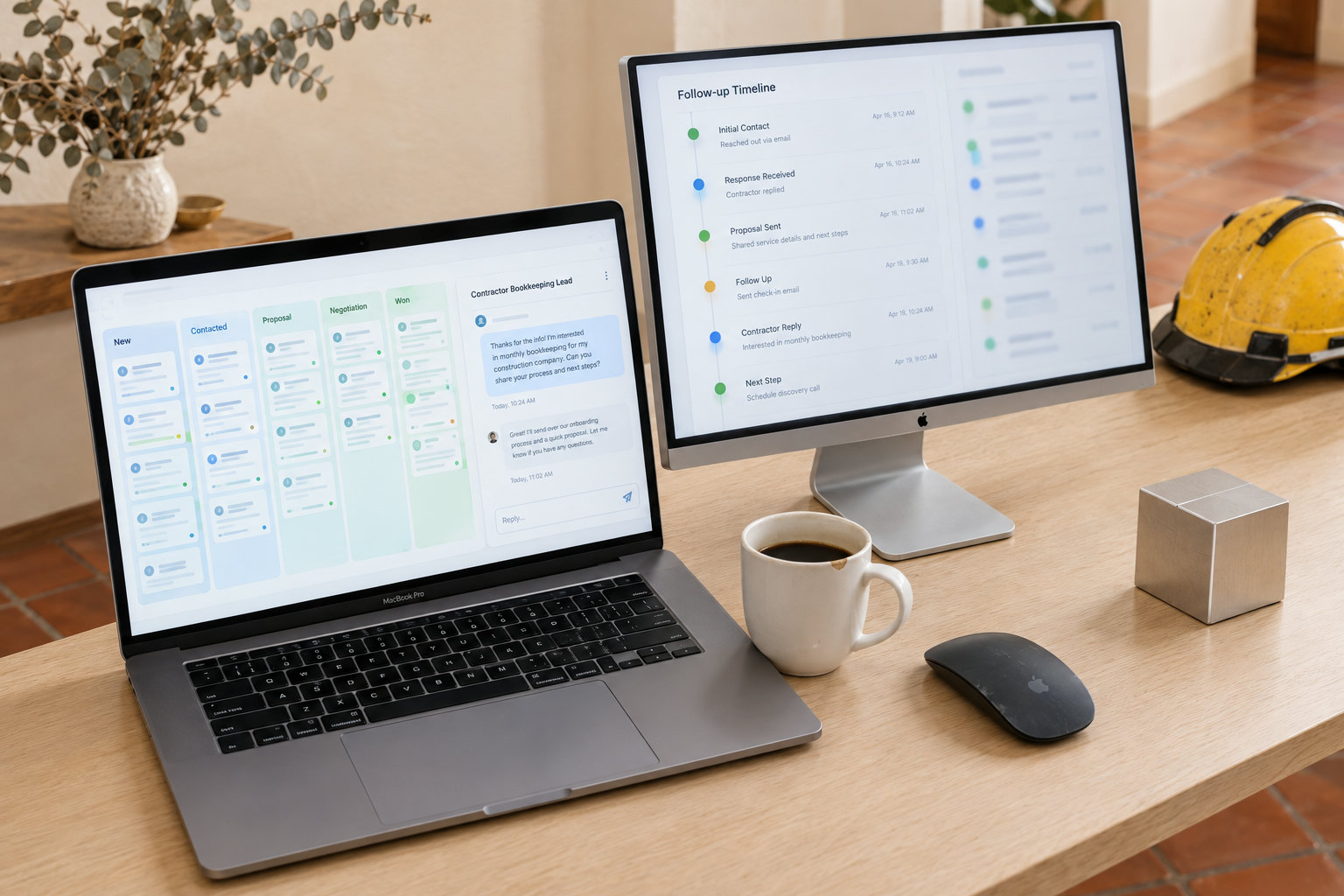
Following up with general contractor bookkeeping leads for Toronto CPA firms works best when you answer the reply within one business day, ask one construction-specific question (job costing, holdbacks or progress billing), and offer two exact meeting times. If the contractor goes quiet, send the next follow-up after 4-7 days, not after 2 days and not after two weeks. The reply is the hard part. Losing it through a slow or generic answer is the most common way firms waste it.
- A contractor’s reply to a cold email should get a personal answer within 24 hours, because interest from a busy site owner cools fast.
- The first reply should ask one construction question, such as how the contractor tracks costs per job, rather than listing your firm’s services.
- Ontario’s Construction Act requires a 10% holdback on most contracts, which makes holdback tracking a natural opening topic for a bookkeeping conversation.
- When a contractor stops replying, the second follow-up belongs in the 4-7 day window, not on day 2-3 and not on day 14 or later.
- Contractors who pay subcontractors must file T5018 slips with the CRA, a recurring obligation that supports a monthly, not one-time, engagement.
- Commercial emails to businesses fall under CASL, so confirm your outreach approach with your regulator or your own counsel.
The Short Answer: Following Up With General Contractor Bookkeeping Leads
Following up with general contractor bookkeeping leads for CPA firms comes down to three moves: reply the same day or the next morning, make the reply about the contractor’s books rather than your firm, and end with a specific ask. A specific ask means “Would Tuesday at 7:30 a.m. or Thursday at 4 p.m. work for a 20-minute call?”, not “Let me know if you’d like to chat.”
Contractors reply from job sites, between inspections, and often from a phone. Short messages, early or late meeting times, and one clear question match how they work. Everything else, including your fee structure, your software stack and your team bios, can wait for the meeting.
The Full Answer
A contractor reply to a cold email can mean many things. It can be a real opening, a polite “maybe later,” or a question about whether you understand construction at all. This section is for CPA and bookkeeping firm owners who already have outbound email running and now need to turn construction replies into booked meetings. It is not about writing the first cold email.
How fast do you need to answer?
A contractor’s reply should get a human answer within 24 hours, and the same business day is better. A common mistake is letting replies sit in a partner’s main inbox, where they get buried under client email during the week. A hot lead can go cold within 24 hours.
The fix is routing. Send replies from your sending tool (Instantly.ai, Smartlead or Lemlist all support a shared reply inbox) to one named person whose job that day is to answer them. If that person is you, block 15 minutes at 7 a.m. and again at 4 p.m. Contractors often handle email during those hours too.
What should the first reply actually say?
The first reply should prove you understand construction books in one sentence, then ask for the meeting. Picture the owner of a renovation and small commercial build company in Etobicoke running three jobs at once, with a part-time bookkeeper who reconciles the bank once a quarter. That owner doesn’t want a capabilities statement. They want to know whether you can tell them which job is losing money.
So ask about something only a construction-literate firm would ask. Examples: how they track costs per job today, whether holdbacks receivable show up separately in their books, or whether progress billings line up with work completed. Ontario’s Construction Act sets a 10% holdback on most contracts and prompt-payment timelines for proper invoices. A contractor who has had cash stuck in holdback will recognize the question immediately.
| What the contractor wrote | What it usually means | Best next move |
|---|---|---|
| “Sure, call me.” | Real interest, little time | Offer two exact times within 3 business days, early morning or late afternoon |
| “What do you charge?” | Interested, but checking whether it’s worth the time | Explain that scope depends on job count and payroll, then book 20 minutes to quote properly |
| “We have a bookkeeper.” | Not unhappy enough yet, or loyal | Ask one question about job costing or year-end, and offer a second-opinion review |
| “Maybe after the season.” | Timing, not a no | Agree on a date, put it in HubSpot or Salesforce, and follow up then |
| “Our books are a mess.” | Strongest buying signal | Propose a catch-up engagement that rolls into monthly bookkeeping |
What if the contractor goes quiet after the first reply?
A contractor who replied once and then went silent is still a warm lead. A common mistake is sending the next message too early (day 2 or 3) or too late (day 14 or later). The useful window is 4-7 days, and many in-house teams never send a second message at all.
Each follow-up should add something new: a one-line point about T5018 slips for subcontractor payments, a note on HST timing, or a question about WSIB clearance records. Don’t send “just checking in.” Three thoughtful follow-ups over roughly three weeks is a reasonable ceiling before you park the lead for a later date.
Write one sentence on their situation, ask one construction question, and offer two meeting times.
Bring up holdbacks, T5018 reporting or job costing, and repeat the meeting offer with fresh times.
Ask whether now is the wrong time and when you should check back. A dated answer is worth logging.
Record the reason and the next date in HubSpot or Salesforce so the lead returns on schedule.
Should the meeting be about monthly bookkeeping or a cleanup?
The first meeting with a contractor should usually lead with the problem in front of them, which is often a cleanup, and then show how a monthly engagement keeps it from coming back. Contractors rarely wake up wanting “monthly bookkeeping.” They want to know whether a job made money, why the bank balance doesn’t match what they think they’re owed, and how to get through year-end without a scramble.
The recurring obligations make the case for monthly work on their own. T5018 reporting, HST filings, payroll remittances, holdback tracking and WIP for bonding or bank covenants all happen on a schedule. Once the books are caught up, ask a simple question in the meeting: who is going to keep them this way?
Who should handle the replies: you, a staff member or an agency?
Reply handling for contractor leads can sit with a partner, a trained staff member or an outside team, as long as one person owns it and answers every reply within a day. Partners write the most convincing replies but have the least time. A junior staff member has time but may not be able to answer a holdback question on the spot.
This is the work Best Leads does for clients: we build the cold email system and sending infrastructure, write and A/B test the copy, manage the replies and book interested prospects directly on your calendar, with regular check-ins. If you’re weighing that route, our page on lead generation for accounting and CPA firms explains how the setup works, and our guide on how to choose a lead generation company for accounting firms lists the questions to ask before you hire anyone, including us.
Answer within 24 hours, ask one construction question, and offer two exact meeting times. If the contractor goes quiet, follow up after 4-7 days with a new point. Lead the meeting with the cleanup problem and show how monthly work prevents it.
When the Answer Is Different
The standard follow-up for general contractor replies changes in a few situations. Here are the main ones.
The reply comes from an office manager or spouse who keeps the books. This person is the one your service would affect most. Write to them as a colleague, not as a gatekeeper, and suggest a call that includes both them and the owner.
The contractor asks you to stop emailing. Stop, confirm the removal in your sending tool, and don’t send anything else. Canada’s Anti-Spam Legislation (CASL) covers commercial electronic messages between businesses and requires a working unsubscribe. Treat this as general information and confirm your own approach with your regulator or your own counsel.
The contractor is larger than you expected. A builder with a full-time controller and bonding requirements may need fractional CFO or advisory work rather than bookkeeping. Change the offer instead of forcing a monthly bookkeeping pitch.
Your follow-up makes claims about results. CPA Ontario has advertising and promotion rules that apply to members. Keep your follow-ups factual, avoid comparisons you can’t support, and check the current rules with CPA Ontario directly.
Our view
This is our opinion: firms put too much weight on the wording of the first cold email and too little on what happens after a contractor replies. Following up with general contractor bookkeeping leads for CPA firms is a scheduling and ownership problem more than a copywriting one. Who answers, how fast, and whether the next date gets logged all matter more than a clever subject line.
We’d also argue that speaking the contractor’s language is your real edge. A firm that asks about holdbacks and WIP on the first reply sounds like it already does the work. Firms that list services sound like everyone else.
Best Leads brings 10+ years of navigating complex sales to building these systems, on agreed upfront monthly prices with no hidden charges or cancellation fees. If the meeting itself is where deals stall, our sales coaching for accounting firms focuses on that conversation.
- Should a Toronto Accounting Firm Target New Businesses or Established Companies to Get More Bookkeeping Clients?
- How Do I Measure the Success of My Cold Email Campaigns? Qualified Replies vs Booked Meetings for Toronto CPA Firms
- B2B Appointment Setting for a North York Staffing Firm That Hadn’t Booked a New Client Meeting in 4 Months — How We Fixed It in 30 Days
- Cold Outreach Campaign for a Toronto B2B Recruitment Firm That Had Tried Lemlist In-House and Gotten 0 Replies — What We Did Differently
- Cold Email Rules for CPA Firms in Toronto: Can a Client Referral Justify an Introductory Email?
Frequently Asked Questions
How many follow-ups should a contractor lead get?
A contractor lead that replied once can reasonably get three follow-ups over about three weeks, spaced 4-7 days apart. After that, log a check-back date in HubSpot or Salesforce instead of continuing to email.
Should I quote pricing in the follow-up email?
Pricing for contractor bookkeeping depends on job count, payroll, subcontractor volume and the state of the books, so it is usually better scoped on a 20-minute call. Tell the contractor that honestly and offer two specific times.
What tools help manage contractor replies?
Instantly.ai, Smartlead and Lemlist provide shared reply inboxes for cold email, while HubSpot and Salesforce track follow-up dates and meeting outcomes. Outreach suits firms that already run a larger sales team.
Can a Toronto CPA firm cold email contractors at all?
Business-to-business cold email to contractors is common, but it falls under CASL and, for members, under CPA Ontario’s advertising rules. Confirm your specific approach with your regulator or your own counsel before launching.
Sources
- Holdback and prompt payment rules on Ontario construction contracts: Construction Act, Government of Ontario
- T5018 reporting of payments to subcontractors: Canada Revenue Agency, Contract Payment Reporting System
- Commercial electronic message rules: Canada’s Anti-Spam Legislation, Government of Canada
- Member advertising and promotion guidance: CPA Ontario
Best Leads
Our Primary Offerings: Reliable Lead Generation Email Marketing Services.
Have Us Book Your Contractor Bookkeeping Meetings in Toronto →